Na inauguração do Scriptorium Fidei, uma obra em língua portuguesa se apresenta ao mundo com uma ambição que só será digna se permanecer de joelhos diante de Deus e sob o manto de Nossa Senhora.
Por Altamirando von Galen
Há inaugurações que pedem champanhe.
Outras pedem silêncio.
Quando uma obra nasce para servir à verdade católica, talvez a primeira palavra devesse ser ainda mais simples:
Deo gratias.
Graças a Deus.
Não porque uma página tenha sido publicada na internet. A internet recebe páginas novas a cada segundo e as esquece com a mesma rapidez. Não porque um endereço eletrônico tenha começado a responder. Servidores respondem; máquinas funcionam; domínios são registrados. Nada disso, por si só, merece solenidade.
A solenidade começa quando uma obra aceita responder por aquilo que pretende servir.
Hoje se abre o Scriptorium Fidei.
O nome já traz uma obrigação.
Um scriptorium não era uma sala de opiniões rápidas. Era o lugar do trabalho paciente, da letra examinada, da palavra preservada, da inteligência disciplinada pela responsabilidade de transmitir algo que não pertencia apenas ao copista. Homens curvavam-se durante horas sobre pergaminhos porque sabiam que certas palavras mereciam atravessar séculos.
Nós, modernos, curvamo-nos sobre telas.
A diferença de postura física talvez seja pequena.
A diferença de espírito pode ser imensa.
O nosso tempo produz informação em quantidade jamais imaginada. E justamente por isso sofre de uma pobreza singular: tornou-se difícil distinguir informação de ruído, documento de impressão, fato de propaganda, tradição de nostalgia, autoridade de celebridade, religião de sociologia religiosa.
O problema já não é encontrar palavras.
É encontrar palavras que respondam à verdade.
É nesse ambiente que o Scriptorium Fidei se apresenta com uma intenção deliberadamente grande: tornar-se referência mundial, em língua portuguesa, para a informação católica.
A frase é ambiciosa.
Que permaneça assim.
Há uma falsa humildade que reduz antecipadamente uma obra para que ninguém possa acusá-la de ter desejado demais. É uma forma elegante de não arriscar. O Evangelho nunca ensinou que os talentos devam ser enterrados para evitar a aparência de presunção.
Mas uma ambição católica precisa de uma disciplina que o mundo raramente entende.
Ela pode desejar alcance sem desejar glória própria.
Pode desejar influência sem desejar poder.
Pode desejar excelência sem desejar aplauso.
Pode desejar ser referência desde que saiba, todos os dias, que a Referência não é ela.
A verdade não nasce no Scriptorium Fidei.
Não será fabricada por seus autores, editada por seus sistemas nem aperfeiçoada por seus leitores.
A verdade precede a obra.
E, no que há de mais alto, tem um Nome.
Por isso, no dia em que esta casa abre suas portas, seria pouco falar apenas de jornalismo, tecnologia, alcance, audiência ou futuro.
É preciso começar por Deus.
Se esta obra algum dia conseguir separar com clareza um fato de uma interpretação, Deo gratias.
Se conseguir colocar diante do leitor o documento inteiro quando outros lhe oferecem apenas uma frase arrancada do contexto, Deo gratias.
Se corrigir uma falsidade repetida mil vezes, Deo gratias.
Se recordar uma doutrina esquecida, recuperar uma memória soterrada, explicar uma controvérsia sem sacrificar a verdade à torcida ou impedir que uma alma confunda barulho com Magistério, Deo gratias.
E se crescer, que cresça para servir.
Se alcançar muitos países, que os alcance para servir.
Se um dia se tornar referência, que tenha a lucidez de considerar essa palavra não como uma medalha, mas como uma responsabilidade mais pesada.
Porque ser referência significa que alguém, talvez longe, talvez cansado, talvez confuso, acreditará que vale a pena conferir aqui antes de formar um juízo.
Esse leitor será uma espécie de credor.
Terá direito ao nosso trabalho melhor.
A língua portuguesa merece esse trabalho.
Ela levou o nome de Cristo por oceanos, atravessou continentes, ergueu igrejas, registrou sermões, poemas, catecismos, cartas missionárias, tratados, crônicas e orações. Foi língua de impérios e de aldeias, de reis e pescadores, de universidades e procissões.
Hoje une comunidades católicas separadas por mares, continentes e experiências históricas muito diferentes.
Há algo de belo em imaginar que uma obra nascida no Brasil possa falar, na mesma língua, a Lisboa e a Luanda, a Braga e a Maputo, a Porto Alegre e a Díli, às comunidades portuguesas espalhadas pelo mundo e a qualquer leitor que tenha aprendido a rezar, discutir e procurar a verdade em português.
Não para uniformizar essas vozes.
Para oferecer-lhes uma casa comum de leitura.
Uma casa católica.
E uma casa católica não pode ser construída apenas com informação.
Precisa de memória.
O catolicismo não começou na manhã em que abrimos o navegador. A Igreja não nasceu com a última coletiva de imprensa, nem a doutrina começa no documento mais recente, nem a história pode ser remontada segundo a conveniência do debate da semana.
Há vinte séculos atrás de nós.
Concílios. Padres. Doutores. Mártires. Papas. Santos. Liturgias. Controvérsias que julgávamos novas e que já envelheceram três vezes. Erros que mudaram de roupa. Verdades que sobreviveram a todos eles.
Um scriptorium digno desse nome deve saber abrir a janela para o presente sem incendiar a biblioteca para receber mais luz.
Fides. Traditio. Veritas.
As três palavras não são ornamento heráldico.
Elas estabelecem uma ordem.
A fé impede que a informação católica se transforme numa curiosidade externa sobre a Igreja. A tradição impede que o presente se julgue órfão e soberano. A verdade impede que a fé seja reduzida a identidade de grupo e que a tradição se torne apenas preferência estética.
As três exigem trabalho.
E todas exigem humildade.
Há ainda uma Senhora a quem esta casa deve ser confiada.
Seria estranho inaugurar um Scriptorium Fidei, falar da Palavra, da sabedoria, da transmissão da fé e não olhar para aquela em quem a Palavra se fez carne.
Nossa Senhora não escreveu editoriais.
Fez algo maior.
Guardou palavras em seu coração.
Aquela breve expressão do Evangelho contém uma escola inteira para qualquer obra que pretenda falar da Igreja.
Guardar antes de falar.
Contemplar antes de concluir.
Receber antes de transmitir.
Permanecer junto à Cruz quando a verdade deixa de parecer vitoriosa.
E estar com a Igreja quando o Espírito Santo transforma homens temerosos em testemunhas.
Por isso, que Nossa Senhora seja para esta obra mais do que uma devoção colocada na margem.
Que seja patrocínio.
Que a Sedes Sapientiae ensine inteligência.
Que a Mater Ecclesiae ensine amor à Igreja sem servilismo e crítica sem amargura.
Que a Virgo Fidelis ensine constância quando a moda exigir capitulação.
Que a Stella Maris ensine direção quando a correnteza digital quiser decidir o rumo.
E que a Mãe de Deus nos recorde a medida exata de toda grandeza cristã: “Minha alma engrandece o Senhor.”
Não a si mesma.
O Senhor.
Talvez seja essa a oração necessária para o dia de uma inauguração.
Que o Scriptorium Fidei cresça — mas que Deus seja engrandecido.
Que tenha leitores — mas que os leitores sejam conduzidos ao que é verdadeiro.
Que adquira autoridade — mas que jamais confunda autoridade editorial com infalibilidade.
Que possua coragem — mas não a coragem barata de gritar mais alto.
Que possua prudência — mas não a prudência covarde de ocultar aquilo que deveria dizer.
Que saiba corrigir os outros e, mais difícil, corrigir-se.
Que saiba defender a tradição sem transformá-la em fetiche.
Que saiba amar Roma sem confundir a Igreja com a administração de uma época.
Que saiba examinar o presente sem ser prisioneiro dele.
Que saiba olhar para o mundo sem pedir licença ao mundo para continuar católico.
E que jamais troque a verdade por audiência.
Há métricas para quase tudo na internet.
Cliques. Impressões. Sessões. Conversões. Tempo de permanência. Alcance.
São úteis. Seria pueril desprezá-las.
Mas há um tipo de êxito que nenhuma plataforma consegue medir.
Um leitor que abandona uma falsidade.
Uma pessoa que abre pela primeira vez um documento que só conhecia por caricaturas.
Um jovem que descobre que a tradição da Igreja é maior do que a guerra cultural de sua geração.
Um católico desanimado que percebe que não está sozinho.
Uma alma que, entre uma notícia e outra, se lembra de Deus.
Se um dia isso acontecer por meio desta obra, o número não aparecerá no painel.
Estará no lugar certo.
Diante de Deus.
É por isso que a inauguração merece alguma magnificência.
Não a magnificência do triunfo antecipado.
A magnificência das coisas que começam diante de um horizonte maior que elas mesmas.
Uma biblioteca vazia na primeira manhã já contém, de certo modo, todos os livros que espera receber.
Uma catedral quando ainda é pedra fundamental já aponta para o altar.
Um navio no momento de deixar o porto não possui o oceano — mas precisa saber para onde orientará a proa.
O Scriptorium Fidei deixa hoje o porto.
Não sabemos até onde chegará.
Seria presunçoso anunciar a própria grandeza antes que o tempo a prove.
Mas é lícito anunciar a intenção.
Queremos servir à verdade católica com rigor.
Queremos que a língua portuguesa tenha uma casa de informação em que documento valha mais do que rumor, memória mais do que moda e fé mais do que conveniência.
Queremos falar ao Brasil e além dele.
Queremos aprender, corrigir, crescer e merecer confiança.
E queremos fazê-lo sem esquecer que toda obra humana, por bela que seja, um dia passará.
A Verdade que serve não passará.
Assim, neste primeiro dia, convém terminar como se começa uma igreja, uma viagem ou um trabalho digno:
com uma entrega.
A Deus, toda a glória.
A Nosso Senhor Jesus Cristo, princípio e fim de toda verdade que salva.
À Santíssima Virgem Maria, o patrocínio desta casa e o pedido para que jamais falte aqui amor à Igreja, inteligência, fortaleza e fidelidade.
À Igreja Católica, o serviço.
Aos leitores, respeito suficiente para nunca lhes oferecer conscientemente menos do que o melhor que pudermos apurar e escrever.
E a nós, a obrigação de recordar que um scriptorium não existe para fazer barulho.
Existe para guardar e transmitir aquilo que merece não ser perdido.
Que Deus abençoe esta obra.
Que Nossa Senhora a cubra com seu manto.
E que, quando um dia se fizer a história do Scriptorium Fidei, se possa dizer não que foi grande, mas algo muito melhor:
foi fiel.
English Edition · Read in English
Chronicle: A House Raised for Truth
At the inauguration of Scriptorium Fidei, a Portuguese-language work presents itself to the world with an ambition that will be worthy only if it remains on its knees before God and beneath the mantle of Our Lady.
By Altamirando von Galen
Some inaugurations call for champagne.
Others call for silence.
When a work is born to serve Catholic truth, perhaps its first word should be simpler still:
Deo gratias.
Thanks be to God.
Not because a new page has appeared on the internet. The internet receives new pages every second and forgets them with equal speed. Not because an electronic address has begun to respond. Servers respond; machines work; domains are registered. None of this, by itself, deserves solemnity.
Solemnity begins when a work accepts responsibility for what it intends to serve.
Today Scriptorium Fidei opens its doors.
The name already carries an obligation.
A scriptorium was not a room for quick opinions. It was a place of patient labour, of examined letters, of words preserved, of intelligence disciplined by the responsibility of transmitting something that did not belong to the copyist alone. Men bent for hours over parchment because they knew that certain words deserved to cross centuries.
We moderns bend over screens.
The difference in physical posture may be small.
The difference in spirit can be immense.
Our age produces information in quantities never imagined. And precisely for that reason it suffers from a singular poverty: it has become difficult to distinguish information from noise, document from impression, fact from propaganda, tradition from nostalgia, authority from celebrity, religion from the sociology of religion.
The problem is no longer finding words.
It is finding words that answer to truth.
It is in this environment that Scriptorium Fidei appears with a deliberately large intention: to become a worldwide reference in Portuguese for Catholic information.
The sentence is ambitious.
Let it remain so.
There is a false humility that diminishes a work in advance so that no one can accuse it of desiring too much. It is an elegant way of avoiding risk. The Gospel never taught that talents should be buried in order to avoid the appearance of presumption.
But Catholic ambition requires a discipline the world rarely understands.
It may desire reach without desiring its own glory.
It may desire influence without desiring power.
It may desire excellence without desiring applause.
It may desire to become a reference, provided it remembers every day that it is not the Reference.
Truth is not born at Scriptorium Fidei.
It will not be manufactured by its authors, edited into existence by its systems, or perfected by its readers.
Truth precedes the work.
And, at its highest, it has a Name.
For this reason, on the day this house opens its doors, it would be too little to speak only of journalism, technology, reach, audience or future.
We must begin with God.
If this work ever succeeds in distinguishing clearly between a fact and an interpretation, Deo gratias.
If it can place the whole document before the reader when others offer only a sentence torn from context, Deo gratias.
If it corrects a falsehood repeated a thousand times, Deo gratias.
If it recalls a forgotten doctrine, recovers a buried memory, explains a controversy without sacrificing truth to faction, or prevents a soul from confusing noise with Magisterium, Deo gratias.
And if it grows, let it grow to serve.
If it reaches many countries, let it reach them to serve.
If one day it becomes a reference, let it have the clarity to regard that word not as a medal but as a heavier responsibility.
For to be a reference means that someone, perhaps far away, perhaps tired, perhaps confused, will believe it worthwhile to look here before forming a judgment.
That reader will be a kind of creditor.
He will have a right to our best work.
The Portuguese language deserves that work.
It carried the name of Christ across oceans, crossed continents, raised churches, recorded sermons, poems, catechisms, missionary letters, treatises, chronicles and prayers. It was the language of empires and villages, kings and fishermen, universities and processions.
Today it unites Catholic communities separated by seas, continents and very different historical experiences.
There is something beautiful in imagining that a work born in Brazil might speak, in the same language, to Lisbon and Luanda, Braga and Maputo, Porto Alegre and Dili, to Portuguese communities scattered across the world and to every reader who learned to pray, argue and seek truth in Portuguese.
Not to make these voices uniform.
To offer them a common house of reading.
A Catholic house.
And a Catholic house cannot be built from information alone.
It needs memory.
Catholicism did not begin on the morning we opened a browser. The Church was not born with the latest press conference, doctrine does not begin with the most recent document, and history cannot be rebuilt according to the convenience of this week’s debate.
Twenty centuries stand behind us.
Councils. Fathers. Doctors. Martyrs. Popes. Saints. Liturgies. Controversies we thought were new and which have already grown old three times. Errors that changed clothes. Truths that survived them all.
A scriptorium worthy of the name must know how to open the window to the present without burning the library in order to receive more light.
Fides. Traditio. Veritas.
The three words are not heraldic decoration.
They establish an order.
Faith prevents Catholic information from becoming an external curiosity about the Church. Tradition prevents the present from considering itself orphaned and sovereign. Truth prevents faith from being reduced to group identity and tradition from becoming merely an aesthetic preference.
All three require work.
And all require humility.
There is also a Lady to whom this house must be entrusted.
It would be strange to inaugurate a Scriptorium Fidei, to speak of the Word, wisdom and the transmission of faith, and not look toward the one in whom the Word became flesh.
Our Lady did not write editorials.
She did something greater.
She kept words in her heart.
That brief expression from the Gospel contains an entire school for any work that intends to speak about the Church.
Keep before speaking.
Contemplate before concluding.
Receive before transmitting.
Remain beside the Cross when truth ceases to look victorious.
And remain with the Church when the Holy Spirit turns fearful men into witnesses.
Therefore, may Our Lady be more to this work than a devotion placed in the margin.
May she be its patronage.
May the Sedes Sapientiae teach intelligence.
May the Mater Ecclesiae teach love for the Church without servility and criticism without bitterness.
May the Virgo Fidelis teach constancy when fashion demands capitulation.
May the Stella Maris teach direction when the digital current tries to determine the course.
And may the Mother of God remind us of the exact measure of all Christian greatness: “My soul magnifies the Lord.”
Not itself.
The Lord.
Perhaps this is the prayer needed on an inauguration day.
May Scriptorium Fidei grow — but may God be magnified.
May it have readers — but may those readers be led toward what is true.
May it acquire authority — but may it never confuse editorial authority with infallibility.
May it possess courage — but not the cheap courage of shouting louder.
May it possess prudence — but not the cowardly prudence of hiding what ought to be said.
May it know how to correct others and, more difficult still, correct itself.
May it defend tradition without turning it into a fetish.
May it love Rome without confusing the Church with the administration of an age.
May it examine the present without becoming its prisoner.
May it look at the world without asking the world’s permission to remain Catholic.
And may it never exchange truth for audience.
There are metrics for almost everything on the internet.
Clicks. Impressions. Sessions. Conversions. Time on page. Reach.
They are useful. It would be childish to despise them.
But there is a kind of success no platform can measure.
A reader who abandons a falsehood.
A person who opens for the first time a document previously known only through caricatures.
A young Catholic who discovers that the Church’s tradition is greater than the culture war of his generation.
A discouraged Catholic who realizes he is not alone.
A soul who, between one news item and another, remembers God.
If one day that happens through this work, the number will not appear on a dashboard.
It will be in the right place.
Before God.
That is why an inauguration deserves a certain magnificence.
Not the magnificence of a triumph announced in advance.
The magnificence of things that begin before a horizon greater than themselves.
An empty library on its first morning already contains, in a way, all the books it hopes to receive.
A cathedral when it is still a foundation stone already points toward the altar.
A ship at the moment it leaves harbour does not possess the ocean — but it must know how it will set its bow.
Scriptorium Fidei leaves harbour today.
We do not know how far it will go.
It would be presumptuous to announce its greatness before time proves it.
But it is lawful to announce the intention.
We want to serve Catholic truth with rigour.
We want the Portuguese language to have a house of information in which document is worth more than rumour, memory more than fashion, and faith more than convenience.
We want to speak to Brazil and beyond.
We want to learn, correct, grow and deserve trust.
And we want to do so without forgetting that every human work, however beautiful, will one day pass away.
The Truth it serves will not pass away.
So on this first day, it is fitting to end as one begins a church, a journey or any worthy work:
with an offering.
To God, all glory.
To Our Lord Jesus Christ, the beginning and end of every truth that saves.
To the Blessed Virgin Mary, the patronage of this house and the prayer that love for the Church, intelligence, fortitude and fidelity may never be lacking here.
To the Catholic Church, service.
To our readers, enough respect never knowingly to offer them less than the best we can investigate and write.
And to ourselves, the obligation to remember that a scriptorium does not exist to make noise.
It exists to preserve and transmit what deserves not to be lost.
May God bless this work.
May Our Lady cover it with her mantle.
And when, one day, the history of Scriptorium Fidei is written, may it be said not that it was great, but something far better:
it was faithful.
Fontes e documentos
Scriptorium Fidei — site oficial.
https://scriptoriumfidei.com.br/
Sagrada Escritura — Salmo 113B (115),1; Lucas 1,46–49 e 2,19; João 1,14.
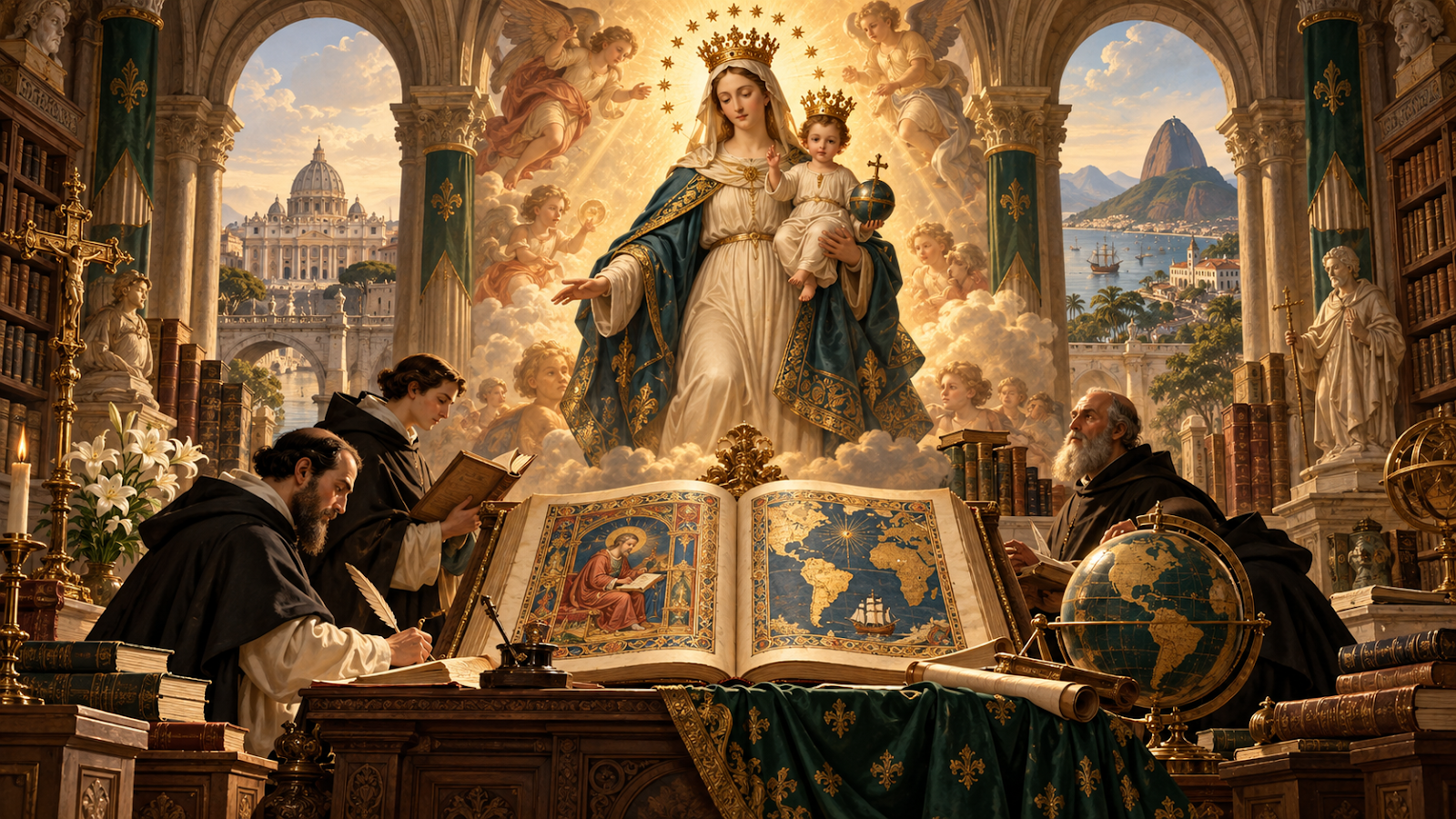
Imagem: Sob o patrocínio de Nossa Senhora, o Scriptorium Fidei abre sua casa à verdade católica em língua portuguesa. — Gravura editorial do Scriptorium Fidei.

