Christian Würtz não imagina Eichstätt fora da corrente sinodal alemã. Teresia Ludibunda recorda que um bispo recebe a fé para guardá-la — não a corrente para acompanhá-la.
Por Teresia Ludibunda
Há objetos cujo formato já contém uma advertência.
O báculo episcopal, por exemplo.
Ele não foi desenhado como remo.
Talvez isso pareça uma observação elementar. Mas os tempos eclesiais têm o mérito pedagógico de obrigar-nos a reaprender o óbvio.
Christian Würtz, recém-empossado como bispo de Eichstätt, declarou que não consegue imaginar sua diocese “completamente fora” do percurso sinodal alemão e que, se a futura Conferência Sinodal receber reconhecimento de Roma, não vê motivo para não participar.
Há um “se” importante na frase.
Convém não apagá-lo.
Würtz não disse que participará de qualquer organismo, em quaisquer condições, contra Roma. Condicionou a participação ao reconhecimento romano.
Muito bem.
Mas a parte mais reveladora vem antes.
Ele não consegue imaginar Eichstätt fora do caminho “que toda a Igreja na Alemanha está percorrendo”.
Toda.
É uma palavra pequena e muito útil.
Quando se diz que “toda” a Igreja de um país está caminhando numa direção, aqueles que não caminham deixam de parecer simplesmente discordantes. Passam a parecer atrasados. Ou excêntricos. Ou obstáculos. Ou, com um pouco mais de imaginação pastoral, “feridas de comunhão”.
A maioria não precisa vencer a discussão.
Basta apresentar-se como paisagem.
Gregor Maria Hanke, antecessor de Würtz, recusou-se a participar do Comitê Sinodal junto com outros bispos alemães. Não por alergia a reuniões, nem porque julgasse que toda consulta aos fiéis fosse uma ameaça à sucessão apostólica. Sua objeção era mais incômoda: temia que o processo se destacasse da tradição da Igreja e da comunhão da Igreja universal.
Em 2022, depois de uma assembleia particularmente tensa, Hanke disse que via em certos textos não desenvolvimento, mas ruptura, sobretudo no campo da antropologia cristã. Antes disso, já advertira que o Caminho Sinodal poderia produzir muitos votos e, ao final, isolar-se precisamente da Tradição e da Igreja universal.
Uma posição dessas tem pouca utilidade para a administração do consenso.
Ela cria atrito.
Atrito é desagradável.
Atrito atrasa o fluxo.
E a cultura contemporânea descobriu uma forma elegante de evitar conflitos doutrinais: transformar a direção dominante em sinônimo de maturidade.
Quem acompanha é “aberto”.
Quem resiste “não escuta”.
Quem concorda é “sinodal”.
Quem pergunta até onde vai a competência daquela assembleia ainda precisa “aprender a caminhar”.
É um vocabulário admiravelmente funcional.
Não responde à objeção.
Classifica o objetor.
A troca de Hanke por Würtz possui, portanto, um valor simbólico que ultrapassa Eichstätt.
O primeiro aceitava o desconforto de ser um dos poucos.
O segundo sublinha seu temperamento de “team player” e diz que não imagina a diocese fora do caminho que a Igreja alemã estaria seguindo.
Nada há de errado em trabalhar em equipe.
Um bispo que não ouve ninguém torna-se rapidamente uma pequena monarquia doméstica com mitra.
Mas o episcopado não é uma técnica de integração grupal.
O bispo não recebe a sucessão dos Apóstolos para detectar a opinião mediana da sala e aproximar-se dela com prudência estatística.
O Código de Direito Canônico é pouco sensível a esse tipo de conforto. O cânon 386 manda ao bispo ensinar as verdades da fé e proteger firmemente sua integridade e unidade. O cânon 392 obriga-o a promover a disciplina comum de toda a Igreja e vigiar contra abusos.
Toda a Igreja.
Não apenas a conferência nacional.
Não apenas o ambiente católico do país.
Não apenas o grupo mais bem organizado da assembleia.
O diretório Apostolorum Successores é ainda mais inconveniente: diz que a verdade revelada deve ser o critério primário pelo qual o bispo avalia opiniões e ideias que emergem da comunidade cristã e da sociedade.
A ordem dos fatores importa.
A verdade avalia a opinião.
Não a opinião avalia a verdade.
Pode parecer autoritário.
É apenas catolicismo anterior às pesquisas de satisfação.
Há uma tentação moderna de imaginar que a coragem episcopal consiste em aproximar-se cuidadosamente daquilo que já possui maioria.
É uma forma muito singela de heroísmo.
O bispo atravessa a praça cercado pela multidão, percebe para onde todos estão indo e anuncia com solenidade: “Irei convosco”.
Recebe aplausos.
Depois concede entrevista sobre escuta.
Os mártires, por alguma falha de assessoria, costumavam escolher procedimento diverso.
A Igreja nunca ensinou que o bispo deva cultivar a solidão como valor em si mesmo. Seria absurdo. O bispo existe em comunhão com o Papa, com o colégio episcopal e com a Igreja inteira.
Mas comunhão não é conformidade ambiental.
Às vezes, a fidelidade à Igreja universal exige discordar da igreja nacional.
Às vezes, defender aquilo que se recebeu exige suportar o incômodo de não estar “no fluxo”.
E, às vezes, uma cátedra serve precisamente para isso: para que haja alguém sentado que não precise levantar-se toda vez que a sala muda de direção.
O problema alemão não é a existência de debate.
Debater é saudável.
O problema é o conteúdo de algumas das reformas que o próprio Caminho Sinodal resolveu colocar em marcha ou recomendar: revisão magisterial da homossexualidade, bênçãos de casais em situações não conformes à moral matrimonial católica, abertura do celibato obrigatório, mulheres em ministérios sacramentais, redistribuição estrutural do poder, novas formas permanentes de decisão conjunta entre bispos e leigos.
Não estou inventando uma lista conservadora para assustar crianças.
A lista está nos próprios documentos do Caminho Sinodal.
Eles têm papel timbrado.
Em 2022, a Santa Sé precisou declarar oficialmente que o Caminho Sinodal alemão não possuía poder para obrigar bispos e fiéis a adotar novas formas de governo ou novas abordagens de doutrina e moral. Acrescentou que, antes de entendimento com a Igreja universal, não seria permitido instituir novas estruturas oficiais ou doutrinas diocesanas que ameaçassem a comunhão e a unidade da Igreja.
Isso não é uma nota de rodapé irrelevante.
É Roma dizendo à Alemanha: vocês não são a Igreja inteira.
Dois anos depois, num comunicado conjunto entre a Santa Sé e a Conferência Episcopal Alemã, os bispos alemães comprometeram-se a buscar formas de sinodalidade compatíveis com a eclesiologia do Vaticano II, o direito canônico e o processo da Igreja universal, submetendo o resultado à aprovação romana.
É neste ponto que a condição formulada por Würtz — “se Roma reconhecer” — deve ser levada a sério.
Sim.
Se Roma aprovar uma estrutura em termos catolicamente aceitáveis, participar dela não é, por si, capitulação.
Mas isso não resolve o problema editorial da sua frase anterior.
Porque a coragem episcopal é testada antes da homologação.
É testada durante o processo.
É testada quando a pressão ambiental pede ao bispo que trate como “caminho comum” aquilo que contém propostas incompatíveis, tensas ou ao menos profundamente problemáticas em relação ao depósito recebido.
Um bispo não precisa esperar que Roma diga “não” para perceber que algumas coisas não podem transformar-se em “sim” pelo simples acúmulo de votos.
E aqui aparece uma das incoerências mais curiosas da vida eclesial recente.
Para os tradicionalistas, muitos pastores descobrem de repente uma teologia musculosa da autoridade.
Há normas.
Há competências.
Há licenças.
Há limites.
Há documentos que devem ser obedecidos no parágrafo, no inciso, na vírgula e, se possível, na respiração.
Um grupo pede a Missa tradicional?
O direito aparece de capacete.
Um padre usa uma forma litúrgica antiga?
A prudência pastoral veste coturno.
Uma comunidade prefere práticas que sobreviveram séculos?
É hora de evitar “divisões”.
Nada disso seria incoerente se a mesma severidade aparecesse diante de projetos que propõem rever questões muito mais próximas da doutrina, da moral e da constituição sacramental da Igreja.
Mas então o tom costuma mudar.
Surge o diálogo.
A escuta.
O processo.
A complexidade.
A necessidade de acompanhar.
É curioso.
Para a tradição, regulamento.
Para a revolução, discernimento.
Para o missal antigo, prazo.
Para a engenharia eclesial nova, horizonte.
Para quem recebeu demais do passado, suspeita.
Para quem pede demais ao futuro, comissão.
Não se trata de reclamar que tradicionalistas sejam postos acima da lei.
Trata-se de perguntar por que o rigor jurídico parece ter preferência estética.
Alguns desvios despertam o policial.
Outros despertam o facilitador de grupo.
A mesma Igreja que pode falar com enorme precisão sobre qual sacerdote deve pedir qual autorização para celebrar um rito venerável torna-se de repente poética diante de assembleias que pedem revisão de antropologia, sexualidade, ministérios e governo.
“Estamos caminhando.”
Sim.
A questão é para onde.
Há ainda outro aspecto do método alemão que merece atenção.
Não é preciso imaginar conspiração secreta.
Não é preciso supor cardeais numa sala escura traçando setas vermelhas sobre o mapa da Igreja.
Basta ler os documentos em sequência.
O mecanismo é público.
Pode ser descrito como maximalismo incremental.
Primeiro, apresenta-se uma reivindicação muito além do que a disciplina ou a doutrina atualmente permitem.
Isso desloca a janela da discussão.
Aquilo que ontem estava fora da mesa passa hoje a ser “uma questão que precisa ser ouvida”.
Depois, a proposta é envolvida em linguagem pastoral.
Não se pede ainda a mudança total.
Pede-se “abertura”.
“Estudo.”
“Reconhecimento de experiências.”
“Espaço de discernimento.”
Uma primeira concessão aparece.
A concessão deixa de ser apresentada como limite.
Transforma-se no novo ponto de partida.
E então a reivindicação inicial retorna como próximo passo razoável.
Não é magia.
É técnica política elementar.
O extraordinário é vê-la aplicada a uma instituição cuja identidade depende precisamente de não fabricar de novo aquilo que recebeu.
Tome-se o caso das mulheres no ministério sacramental.
O horizonte maximalista permanece.
Quando não se pode obter o resultado final, pede-se que a discussão permaneça institucionalmente aberta, que instâncias internacionais a recebam, que etapas intermediárias sejam reconhecidas.
O mesmo ocorre com moral sexual, celibato e estruturas de governo.
A concessão nunca encerra o processo.
Ela demonstra que o processo deve continuar.
É uma escada rolante teológica.
Quem sobe um degrau descobre que o piso também estava em movimento.
O nome sofisticado para isso é “dinâmica sinodal”.
O nome menos cerimonioso é pressão continuada.
A distinção importa porque a Igreja conhece verdadeiro desenvolvimento.
Ela conhece reforma.
Conhece mudança disciplinar.
Conhece aprofundamento doutrinal.
Conhece até correção de práticas humanas deficientes.
Mas desenvolvimento católico não é o truque de pedir dez para receber três, converter três em direito adquirido e voltar no ano seguinte pedindo sete.
A Revelação não negocia como sindicato.
A constituição sacramental da Igreja não é pauta salarial.
E a Tradição não é a parte rígida do sistema que ainda não passou pelo workshop.
É aqui me permito uma pequena crueldade.
A frase “não imagino que nossa diocese fique completamente de fora” pode parecer conciliadora.
Mas um bispo deveria ser capaz de imaginar.
Deveria imaginar perfeitamente.
Deveria conseguir imaginar sua diocese fora de qualquer processo nacional se esse processo exigisse dela algo incompatível com a fé católica.
Deveria conseguir imaginar-se minoria.
Deveria conseguir imaginar-se criticado.
Deveria conseguir imaginar manchetes chamando-o de retrógrado.
Deveria conseguir imaginar reuniões desconfortáveis.
Deveria conseguir imaginar ser o único a levantar a mão.
Não porque ser minoria torne alguém automaticamente certo.
Mas porque um bispo que não consegue conceber a possibilidade de ficar sozinho já entregou parte do ofício antes da primeira votação.
A coragem não consiste em procurar isolamento.
Consiste em não temê-lo quando a verdade o exige.
Hanke podia estar errado em decisões prudenciais concretas.
Não é canonizado pelo fato de ter dito “não”.
Mas sua postura recordava uma coisa que a cultura da facilitação tende a esquecer: o bispo possui responsabilidade pessoal diante de Deus.
Ele não pode dissolvê-la na expressão “a Igreja na Alemanha”.
Não existe sacramento da ordem coletiva da conferência episcopal.
Nenhum homem é consagrado “membro da maioria”.
O episcopado não é mandato representativo de tendências nacionais.
A própria teologia conciliar que exalta a colegialidade não elimina a responsabilidade própria do bispo em sua Igreja particular.
E quando Würtz diz que quer ser “team player”, vale acrescentar a nota de rodapé que todo bispo deveria carregar bordada dentro da mitra:
a equipe não é o critério.
Cristo é.
Isso vale também para todos os bispos que aplicam duas medidas disciplinares.
Se um pastor é severo com os que pedem uma liturgia antiga, seja igualmente severo com quem relativiza doutrina recebida.
Se exige obediência aos tradicionalistas, exija obediência também aos progressistas.
Se teme divisão causada por uma capela de rito antigo, tema também divisão causada por documentos nacionais que pressionam os limites da moral e dos sacramentos.
Se chama de “comunhão” a submissão dos primeiros, não chame de “diálogo” a obstinação dos segundos.
A coerência episcopal não deveria depender da direção do vento.
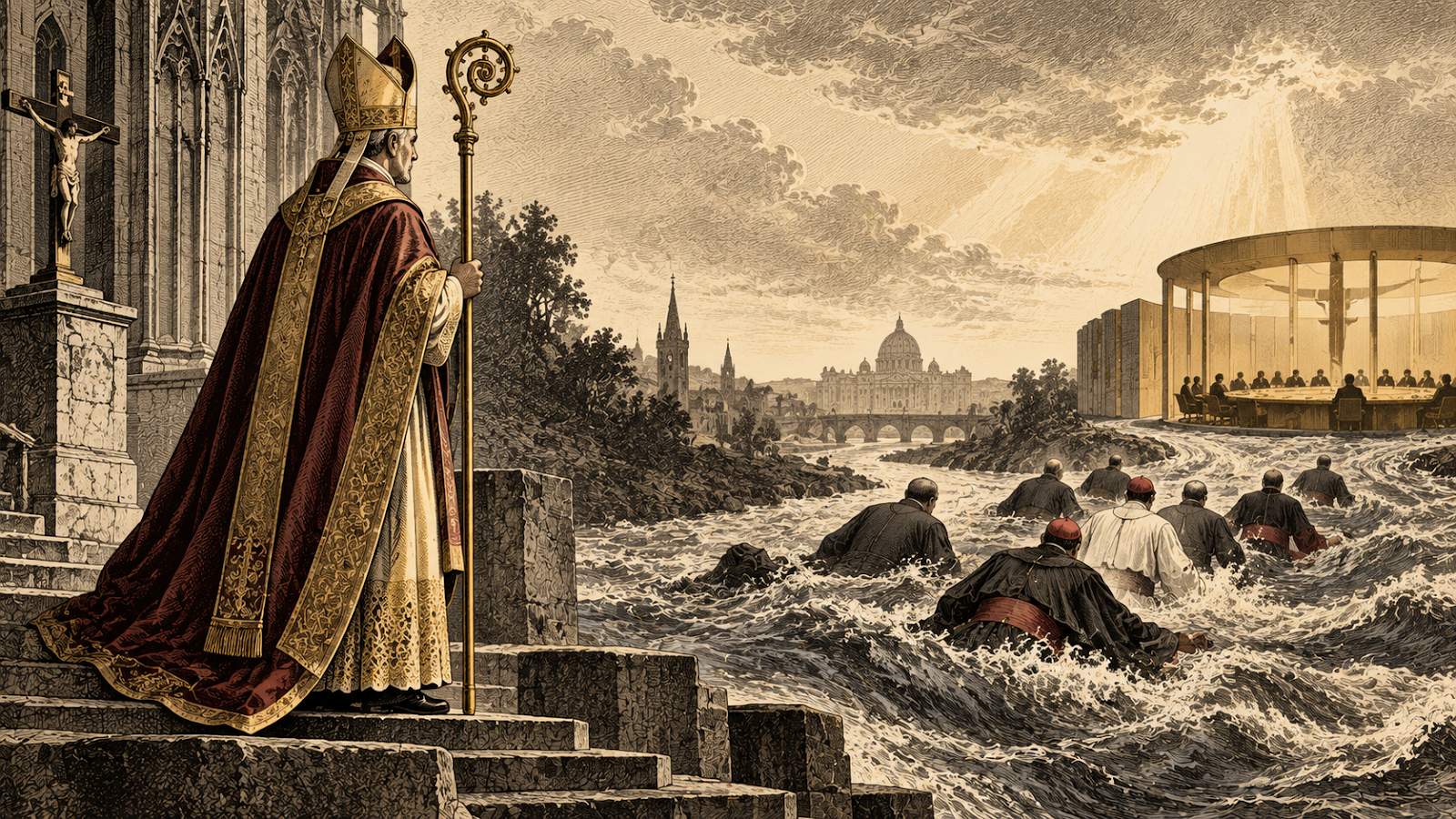
Há um motivo pelo qual a iconografia cristã entrega ao bispo um báculo.
O báculo é sinal de pastor.
Pastor não corre atrás do rebanho perguntando onde ele pretende passar a noite.
Conduz.
Protege.
Chama de volta.
Enfrenta o lobo.
E, quando necessário, fica entre o rebanho e a direção em que o rebanho decidiu correr.
Pode ser cansativo.
Talvez por isso a mitra não venha com travesseiro.
O mais irônico é que o próprio discurso sinodal insiste em “escutar as vozes menos ouvidas”.
Pois bem.
Havia quatro bispos alemães que se recusavam a integrar o Comitê Sinodal.
Eram minoria.
Logo, segundo a retórica oficial, deveriam ser objeto de especial escuta.
Mas minorias conservadoras parecem possuir curioso déficit de minoria.
A escuta prefere as vozes minoritárias que já apontam para a direção majoritária.
As outras são “resistência”.
Isto não é sinodalidade.
É curadoria de dissenso.
Würtz ainda está começando seu governo em Eichstätt.
Seria injusto transformar uma entrevista em profecia de vinte anos.
Ele poderá surpreender.
Poderá estabelecer limites.
Poderá discordar.
Poderá descobrir que “acompanhar” não significa subscrever.
Poderá até recordar que reconhecer juridicamente uma conferência futura não canoniza todas as teses que prepararam o caminho até ela.
Há espaço para prudência.
Mas justamente por isso vale registrar agora a questão.
O que se espera de um bispo quando o ambiente inteiro empurra numa direção?
Não se espera altivez teatral.
Nem prazer em confrontar.
Nem conservadorismo reflexo.
Espera-se algo mais exigente.
Liberdade.
A liberdade de não precisar da aprovação do salão.
A liberdade de ouvir sem se dissolver.
A liberdade de dialogar sem negociar o que não lhe pertence.
A liberdade de distinguir comunhão de conformismo.
A liberdade de dizer sim quando pode dizer sim.
E não quando deve dizer não.
No fim, o problema não é Christian Würtz participar ou não de uma futura Conferência Sinodal aprovada por Roma.
O problema é o princípio pelo qual decide participar.
“Todos estão indo” é argumento para excursão.
Não para sucessor dos Apóstolos.
A Igreja já teve bispos sozinhos contra imperadores, cortes, governos, teólogos da moda e maiorias eclesiásticas temporárias.
Sobreviveu justamente porque alguns não confundiram paz com ausência de tensão.
Há paz que nasce da verdade.
E há paz que nasce quando ninguém mais tem coragem de contrariar a sala.
A segunda é muito mais fácil de organizar.
Basta guardar o báculo.
E pegar o remo.
English Edition · Read in English
Critique: A Crozier Is Not an Oar
Christian Würtz cannot imagine Eichstätt standing outside the German synodal current. Teresia Ludibunda recalls that a bishop receives the faith in order to guard it — not the current in order to follow it.
By Teresia Ludibunda
Some objects contain a warning in their very shape.
An episcopal crozier, for example.
It was not designed as an oar.
This may sound elementary. Ecclesial times, however, have the pedagogical virtue of forcing us to learn the obvious again.
Christian Würtz, newly installed as Bishop of Eichstätt, has said that he cannot imagine his diocese “completely opting out” of the German synodal process and that, if the future Synodal Conference receives Roman recognition, he sees no reason not to take part.
There is an important “if” in that sentence.
It should not be erased.
Würtz did not say that he would participate in any body, under any conditions, in defiance of Rome. He made participation conditional upon Roman recognition.
Very well.
But the more revealing part comes earlier.
He cannot imagine Eichstätt standing outside the path that “the whole Church in Germany” is taking.
Whole.
A small and useful word.
Once one says that the “whole” Church in a country is moving in one direction, those who do not move with it cease to appear merely dissenting. They begin to look backward. Eccentric. Obstructive. Or, with slightly more pastoral imagination, “wounds to communion.”
The majority need not win the argument.
It need only present itself as the landscape.
Gregor Maria Hanke, Würtz’s predecessor, refused to participate in the Synodal Committee together with several other German bishops. Not because he was allergic to meetings, nor because he thought every consultation of the faithful threatened apostolic succession. His objection was more troublesome: he feared the process could detach itself from the Church’s tradition and from the communion of the universal Church.
In 2022, after a particularly tense assembly, Hanke said he saw in certain texts not development but rupture, especially in Christian anthropology. Earlier, he had already warned that the Synodal Path might pass many resolutions and end by isolating itself precisely from Tradition and the universal Church.
Such a position has little administrative use in the management of consensus.
It creates friction.
Friction is unpleasant.
Friction slows the flow.
Modern ecclesial culture has discovered an elegant way of avoiding doctrinal conflict: treat the dominant direction as a synonym for maturity.
Those who go along are “open.”
Those who resist “do not listen.”
Those who agree are “synodal.”
Those who ask where the competence of an assembly ends still need “to learn how to walk together.”
An admirably functional vocabulary.
It does not answer the objection.
It classifies the objector.
The succession from Hanke to Würtz therefore has a symbolic value beyond Eichstätt.
The first accepted the discomfort of being one of the few.
The second emphasizes his temperament as a “team player” and says he cannot imagine his diocese standing outside the path Germany’s Church is supposedly taking.
There is nothing wrong with teamwork.
A bishop who listens to nobody soon becomes a small domestic monarchy with a mitre.
But the episcopate is not a technique of group integration.
A bishop does not receive apostolic succession in order to detect the median opinion in the room and approach it with statistical prudence.
Canon law is not particularly sensitive to that kind of comfort. Canon 386 binds a bishop to teach the truths of the faith and firmly protect their integrity and unity. Canon 392 obliges him to promote the common discipline of the whole Church and guard against abuses.
The whole Church.
Not merely the national conference.
Not merely the Catholic environment of one country.
Not merely the best-organised group in the assembly.
Apostolorum Successores is even more inconvenient: it says that revealed truth must be the primary criterion by which a bishop evaluates opinions and ideas emerging from the Christian community and society.
The order matters.
Truth evaluates opinion.
Opinion does not evaluate truth.
It may sound authoritarian.
It is simply Catholicism before satisfaction surveys.
There is a modern temptation to imagine episcopal courage as the careful act of drawing near to whatever already commands the majority.
It is a remarkably economical form of heroism.
The bishop crosses the square surrounded by a crowd, notices where everyone is going and solemnly announces: “I shall go with you.”
Applause follows.
Then comes an interview about listening.
Martyrs, perhaps through defective communications advice, tended to choose another procedure.
The Church has never taught that a bishop should cultivate solitude as a value in itself. That would be absurd. A bishop exists in communion with the Pope, the episcopal college and the whole Church.
But communion is not environmental conformity.
At times fidelity to the universal Church requires disagreement with a national church.
At times defending what has been received requires enduring the discomfort of not being “in the flow.”
And at times a cathedra exists precisely so that someone may remain seated without standing every time the room changes direction.
The German problem is not that debate exists.
Debate is healthy.
The problem is the content of some reforms that the Synodal Path itself has voted to advance or recommend: a magisterial re-evaluation of homosexuality, blessings for couples in situations not corresponding to Catholic matrimonial morality, an opening regarding mandatory celibacy, women in sacramental ministries, structural redistribution of power, and permanent new forms of joint decision-making between bishops and laity.
This is not a conservative list invented to frighten children.
The list is found in the Synodal Path’s own documents.
They come with letterhead.
In 2022 the Holy See had to state officially that the German Synodal Path had no power to compel bishops and faithful to adopt new forms of governance or new approaches to doctrine and morals. It added that, before agreement at the level of the universal Church, it would not be permissible to establish new official diocesan structures or doctrines that would threaten ecclesial communion and unity.
That is not an irrelevant footnote.
It is Rome telling Germany: you are not the whole Church.
Two years later, in a joint communiqué between the Holy See and the German Bishops’ Conference, the German bishops committed themselves to pursuing forms of synodality compatible with Vatican II ecclesiology, canon law and the universal synodal process, submitting the result for Roman approval.
This is precisely why Würtz’s condition — “if Rome recognizes it” — must be taken seriously.
Yes.
If Rome approves a structure in genuinely Catholic terms, participation in it is not by itself capitulation.
But that does not solve the editorial problem contained in his previous sentence.
Episcopal courage is tested before homologation.
It is tested during the process.
It is tested when the surrounding environment asks a bishop to treat as “the common path” a process containing proposals incompatible, strained, or at least deeply problematic in relation to the received deposit.
A bishop need not wait for Rome to say “no” before perceiving that some things cannot become “yes” through the mere accumulation of votes.
Here one encounters one of the more curious inconsistencies of recent ecclesial life.
When dealing with traditionalists, many pastors suddenly discover a muscular theology of authority.
There are norms.
Competences.
Permissions.
Limits.
Documents that must be obeyed in paragraph, clause, comma and, if possible, respiration.
A group asks for the traditional Mass?
Law arrives wearing a helmet.
A priest uses an older liturgical form?
Pastoral prudence puts on combat boots.
A community prefers practices that survived for centuries?
Time to avoid “division.”
None of this would be incoherent if the same severity appeared when confronting projects proposing revisions much closer to doctrine, morals and the sacramental constitution of the Church.
But then the tone often changes.
Dialogue appears.
Listening.
Process.
Complexity.
The need to accompany.
Curious.
For tradition, regulation.
For revolution, discernment.
For the old missal, deadlines.
For new ecclesial engineering, horizons.
Those who have received too much from the past are suspect.
Those who demand too much from the future receive a commission.
This is not an argument that traditionalists should stand above the law.
It is a question about why juridical rigor seems to possess aesthetic preferences.
Some deviations awaken the policeman.
Others awaken the group facilitator.
The same Church that can speak with enormous precision about which priest must request which permission to celebrate a venerable rite suddenly becomes poetic before assemblies asking for revisions in anthropology, sexuality, ministries and governance.
“We are walking.”
Yes.
The question is where.
There is another aspect of the German method that deserves attention.
No secret conspiracy need be imagined.
No cardinals in a dark room drawing red arrows over a map of the Church are required.
One need only read the documents in sequence.
The mechanism is public.
It can be described as incremental maximalism.
First, a demand far beyond what present discipline or doctrine allows is introduced.
That shifts the window of discussion.
What yesterday stood outside the table becomes today “a question that must be heard.”
Then the proposal is wrapped in pastoral language.
The total change is not yet demanded.
Instead one asks for “openness.”
“Study.”
“Recognition of experience.”
“Space for discernment.”
A first concession appears.
The concession is no longer presented as a limit.
It becomes the new starting point.
Then the original demand returns as the next reasonable step.
This is not magic.
It is elementary political technique.
What is extraordinary is seeing it applied to an institution whose identity depends precisely on not manufacturing anew what it has received.
Take the question of women in sacramental ministry.
The maximal horizon remains.
When the final outcome cannot be obtained, one asks that the discussion remain institutionally open, that international structures receive it, that intermediate stages be recognised.
The same pattern appears around sexual morality, celibacy and governance.
A concession never ends the process.
It proves that the process must continue.
It is a theological escalator.
Once one climbs one step, one discovers the floor was moving too.
The sophisticated name is “synodal dynamic.”
The less ceremonial name is sustained pressure.
The distinction matters because the Church knows genuine development.
She knows reform.
She knows disciplinary change.
She knows doctrinal deepening.
She even knows the correction of deficient human practices.
But Catholic development is not the trick of asking for ten, receiving three, converting three into an acquired right, and returning next year to demand seven.
Revelation does not bargain like a trade union.
The sacramental constitution of the Church is not a wage negotiation.
Tradition is not the rigid portion of the system still awaiting a workshop.
At this point Teresia Ludibunda permits herself a small cruelty.
The sentence “I cannot imagine our diocese completely opting out” may sound conciliatory.
A bishop, however, should be able to imagine it.
Perfectly.
He should be able to imagine his diocese outside any national process if that process asked something incompatible with the Catholic faith.
He should be able to imagine himself in the minority.
He should be able to imagine criticism.
He should be able to imagine headlines calling him backward.
He should be able to imagine uncomfortable meetings.
He should be able to imagine being the only hand raised.
Not because minority status automatically makes one right.
But because a bishop who cannot conceive the possibility of standing alone has surrendered part of his office before the first vote.
Courage does not consist in seeking isolation.
It consists in not fearing it when truth demands it.
Hanke may have been wrong in particular prudential decisions.
He is not canonised by having said “no.”
But his posture recalled something the culture of facilitation tends to forget: a bishop bears personal responsibility before God.
He cannot dissolve it into the phrase “the Church in Germany.”
There is no sacrament of collective ordination into an episcopal conference.
No man is consecrated “member of the majority.”
The episcopate is not a representative mandate for national tendencies.
Even conciliar theology, with its emphasis on collegiality, does not eliminate the bishop’s proper responsibility in his particular Church.
And when Würtz says he wants to be a “team player,” one might add the footnote every bishop should have embroidered inside his mitre:
the team is not the criterion.
Christ is.
The same applies to every bishop who measures discipline by two standards.
If a pastor is severe toward those who ask for an older liturgy, let him be equally severe toward those who relativise received doctrine.
If he demands obedience from traditionalists, let him demand obedience from progressives too.
If he fears division caused by a chapel using the old rite, let him also fear division caused by national documents pressing against the limits of morals and sacraments.
If he calls the submission of the former “communion,” let him not call the obstinacy of the latter merely “dialogue.”
Episcopal consistency should not depend on the direction of the wind.
There is a reason Christian iconography places a crozier in a bishop’s hand.
It is the sign of a shepherd.
A shepherd does not run behind the flock asking where it intends to spend the night.
He leads.
Protects.
Calls back.
Faces the wolf.
And, when necessary, stands between the flock and the direction in which the flock has decided to run.
It can be tiring.
Perhaps that is why the mitre does not come with a pillow.
The final irony is that synodal rhetoric itself insists on “listening to less-heard voices.”
Very well.
There were four German bishops who refused to join the Synodal Committee.
They were a minority.
By official rhetoric, then, they should have been objects of special listening.
Yet conservative minorities appear to possess a strange deficit of minority status.
Listening prefers minority voices that already point toward the majority’s direction.
The others become “resistance.”
This is not synodality.
It is curated dissent.
Würtz is only beginning his government in Eichstätt.
It would be unjust to turn one interview into a prophecy of twenty years.
He may surprise.
He may establish limits.
He may disagree.
He may discover that “accompanying” does not mean subscribing.
He may even remember that juridical recognition of a future conference would not canonise every thesis that prepared the road toward it.
There is room for prudence.
Which is precisely why the question should be recorded now.
What is expected of a bishop when his entire environment pushes in one direction?
Not theatrical hauteur.
Not pleasure in confrontation.
Not reflexive conservatism.
Something more demanding is expected.
Freedom.
The freedom not to need the room’s approval.
The freedom to listen without dissolving.
The freedom to dialogue without negotiating what does not belong to him.
The freedom to distinguish communion from conformity.
The freedom to say yes when he may say yes.
And no when he must say no.
In the end, the problem is not whether Christian Würtz takes part in a future Synodal Conference approved by Rome.
The problem is the principle by which he decides to take part.
“Everyone is going” is an argument for a school trip.
Not for a successor of the Apostles.
The Church has known bishops standing alone against emperors, courts, governments, fashionable theologians and temporary ecclesiastical majorities.
She survived precisely because some did not confuse peace with the absence of tension.
There is a peace born from truth.
And there is a peace that begins when nobody has the courage left to contradict the room.
The second is much easier to organise.
One need only put away the crozier.
And pick up the oar.
Fontes e documentos
Katholisch.de — “Würtz vor Amtseinführung: Spüre freudige Erwartungshaltung”, 2 out. 2026.
Kirche+Leben — “Ernannter Eichstätter Bischof Würtz: Will bei synodalem Prozess mitmachen”, 2 out. 2026.
Vatican News — “Würtz: ‘Diener der Einheit sein’”, 12 jul. 2026.
Vatican News — “Bischof Hanke: Debatte über Kirchenreformen zu strukturfixiert”, 8 out. 2021.
Vatican News — “D: Bischof Hanke fürchtet Spaltung durch Synodalen Weg”, 19 abr. 2021.
Santa Sé — Declaração sobre o Caminho Sinodal na Alemanha, 21 jul. 2022.
https://press.vatican.va/content/salastampa/en/bollettino/pubblico/2022/07/21/220721e.html
Santa Sé / Conferência Episcopal Alemã — Comunicado conjunto, 22 mar. 2024.
https://press.vatican.va/content/salastampa/en/bollettino/pubblico/2024/03/22/240322d.html
Código de Direito Canônico — cânones 386 e 392.
https://www.vatican.va/archive/cod-iuris-canonici/eng/documents/cic_lib2-cann368-430_en.html
Concílio Vaticano II — Christus Dominus, especialmente nn. 2, 12–15 e 36–38.
Congregação para os Bispos — Apostolorum Successores, Diretório para o Ministério Pastoral dos Bispos, especialmente n. 57.
Der Synodale Weg — “Beschlüsse und weitere Texte”: lista oficial de decisões e textos do Caminho Sinodal.
https://www.synodalerweg.de/beschluesse
Der Synodale Weg — Handreichung “Segnung für Paare, die sich lieben”, 23 abr. 2025.
Imagem: O báculo permanece na margem enquanto a corrente do consenso conduz a assembleia. — Gravura editorial do Scriptorium Fidei.


